
Compressor Condensate Oil Water Separator
Air & Gas Compressor Condensate Oil Water Separator (CCS)
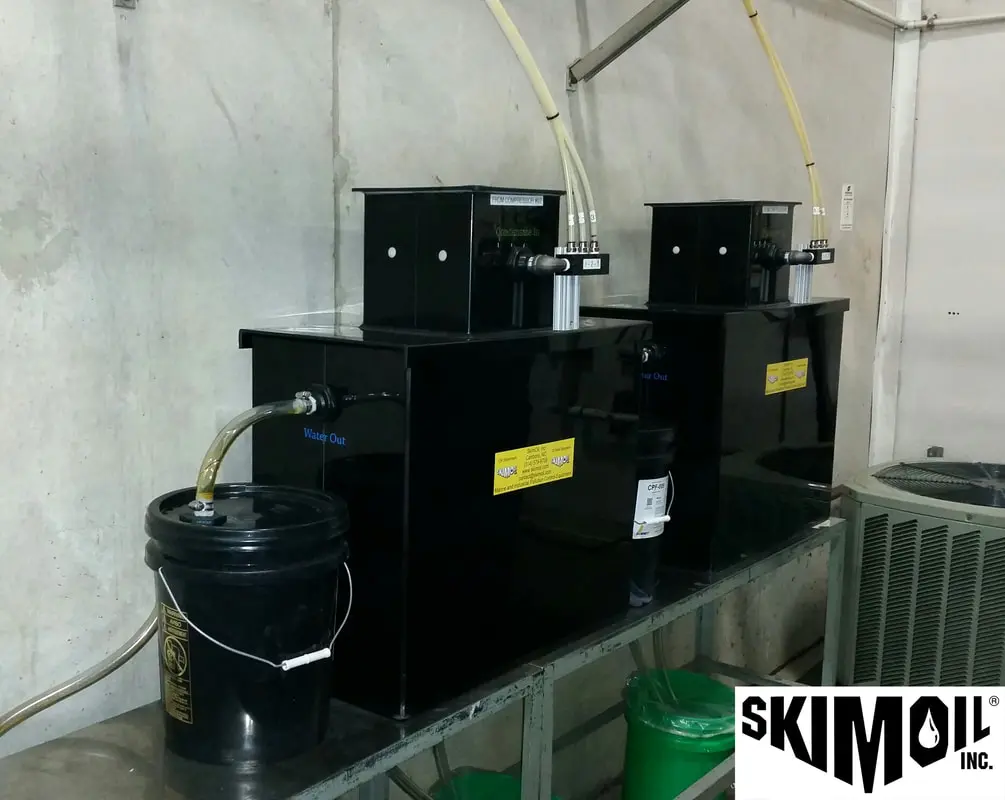
- Specifically built for compressor condensate: Designed to handle the oily water byproduct of compressed air systems
- No moving parts: Simple, rugged design means less maintenance and fewer breakdowns
- Triple-stage separation: Uses gravity, coalescing, and carbon filtration for highly effective oil-water separation
- Rugged and reliable: Built to withstand industrial environments with minimal operator input
- Meets environmental standards: Helps you comply with strict discharge regulations and avoid penalties
- Gravity-fed simplicity: Works without pumps or electricity for passive, efficient operation
- Versatile sizing: Multiple models available to fit a wide range of plant sizes and flow rates
- Produces sheen-free discharge: Carbon polishing stage ensures visibly clean output water
Keep Production Running Smoothly
SkimOIL® Air Compressor Condensate Oil/Water Separators remove oil before it leaves your system, protecting your operation from costly violations. Compact, reliable, and easy to install, these units help you avoid downtime and keep your processes running efficiently.
Compressor Condensate Oil Water Separator Features
This oil water separator is specifically designed to handle air compressor condensate. This separator has NO moving parts and is nearly maintenance free.
01
Design
- No moving parts: Minimal wear and tear ensures long-term reliability
- Turbulence-free chambers: Reduces disruption and improves separation efficiency
- Heavy-duty build: Built for industrial use with rugged, proven materials
02
PERFORMANCE
- Three-stage separation: Coalescing, gravity separation, and carbon filtration
- High residence time: Extended dwell time maximizes oil removal
- Polishing filter: External carbon filter removes remaining trace oils and sheen
03
INSTALLATION
- Gravity-fed system: Simple setup with no need for electrical or mechanical input
- Modular sizes: Models available for varying flow capacities
04
ENVIRONMENTAL COMPLIANCE
- Meets discharge standards: Helps facilities stay within local and federal waste guidelines
- Accepted by sewer districts: Carbon-treated water typically meets public treatment requirements
WHY CCS CONDENSATE SEPARATORS MATTER
Air compressor systems generate oily waste — this unit stops it from entering your drains. Built for plants that prioritize uptime, efficiency, and getting the job done right the first time.
CCS Air Compressor Condensate Oil Water Separator
CCS Air Compressor Condensate Oil Water Separator This oil water separator is specifically designed to handle air compressor condensate. This separator has NO moving parts and is nearly maintenance free. It’s designed to give turbulent free plug flow for maximum oil water separation. A large turbulence free separation chamber provides sufficient residence time for coalescing gravity separation, and the effluent header design and placement insures maximum residence time for separation.
Rugged construction, proper selection and a proven design will assure you of a clean discharge, eliminating the concerns of environmental compliance.
Here’s how it works: Inside of your air compressors, there is a built-in oil-water separator (OWS) that separates the water from the oil that stays inside the compressor that is used to lube the rotary screw and other internal parts. In addition to this built-in OWS, you will also need to use an external oil-water separator (CCS-OWS), designed to keep you from sending oil into the environment via the actual condensate liquid that leaves the compressor.
There’s a LOT of oil out there……Let’s keep it in the right places! During the compression process, outside contaminants such as water vapor, dirt, junk and dust are mixed in with the hot oil. Once the air has cooled down at the end of the compression process, the contaminated condensate is generated.
If this moisture collects anywhere in the distribution system (mainly air receivers, filter bowls or moisture separators), the condensate will get into the compressed air system and cause damage to the pneumatic equipment/system and possibly ruin or cause quality problems with the final product.
Typically a good portion of this condensate winds up going to the lowest spot in the plant’s air delivery system…..such as the scale pits in steel mill operations.
Because of this unavoidable, inconvenient and VERY expensive by-product of using compressed air, an oil-water separator is necessary and beneficial to any compressed air operation.
Download the CCS product brochure
Environmental concerns have produced tough new standards to follow and stiff penalties for those who don’t comply. Most states now consider air compressor condensate as a hazardous waste. In other areas it is at least considered to be a special oily waste, with discharge limits to POTWs or municipal treatment plants. Some plants have it hauled off.
Use our sizing tool to spec the right CCS model.
| Model Number | Tank Capacity (Gallons) | Dimensions (H x L x W) | Condensate Inlet Connection | Oil Drain | Water Drain | Weight |
|---|---|---|---|---|---|---|
| CCS 7.5 | 7.5 | 22-1/4 x 18-3/4 x 11 inches | 1/2 inch | 3/4 inch | 3/4 inch | 25 lbs. |
| CCS 15 | 15 | 30-1/4 x 23-1/2 x 11-3/4 inches | 1/2 inch | 3/4 inch | 3/4 inch | 33 lbs. |
| CCS 30 | 30 | 34-1/4 x 27-1/2 x 13-3/4 inches | 1/2 inch | 3/4 inch | 3/4 inch | 56 lbs. |
| CCS 80 | 80 | 48-1/4 x 31-1/2 x 15-3/4 inches | 1/2 inch | 3/4 inch | 1 inch | 130 lbs. |
| CCS 160 | 160 | 52-1/4 x 42-1/2 x 20-3/4 inches | 1/2 inch | 3/4 inch | 1 inch | 170 lbs. |
| CCS 200 | 200 | 54 x 48 x 24 inches | 1/2 inch | 3/4 inch | 1 inch | 185 lbs. |
| CCS 300 | 300 | 60 x 57 x 28 inches | 1/2 inch | 3/4 inch | 1 inch | 215 lbs. |
| CCS 400 | 400 | 72 x 57 x 29 inches | 1/2 inch | 3/4 inch | 1-1/2 inch | 280 lbs. |
Click on the links below for a spec sheet
CCS 7.5 / CCS 15 / CCS 30 / CCS 80 / CCS 160 / CCS 200 / CCS 300 / CCS 400
Environmental concerns have produced tough new standards to follow and stiff penalties for those who don’t comply. Most states now consider air compressor condensate as a hazardous waste. In other areas it is at least considered to be a special oily waste, with discharge limits to POTWs or municipal treatment plants. Some plants have it hauled off.
How It Works
The 3 Stages of Seperation #1. Two large turbulence-free separation chambers provide adequate dwell or residence time for gravity differential to effect the separation process. When water enters the first chamber the fluid is forced to go thru the coalescer pack where the small oil particles are coalesced and separated from the clean water. Clean water from the bottom chamber is gravity fed to the second chamber where the action is duplicated for better separation.
#2. A second stage of gravity separation plus coalescing media (polypropylene balls or tubes) provides greater turbulence-free residence time for further separation.
#3. A large volume External activated carbon polishing filter (GAC) provides clean and sheen-free water for discharge. Almost all sewer districts accept water from a carbon filter.
As indicated above, coalescing, gravity separation and carbon absorption are the three separation methods used by the Compressor Condensate oil water separator (CCS). Call us on this one. Our people are trained to properly size a unit for your application. While this is not rocket science, it helps to know what you’re doing. We specialize in getting oil out!
HOLD IT HOLD IT HOLD IT….MY OIL DOES NOT SEPARATE …..HUH? Wait…..I have some condensate with oils that don’t separate out. What now? Some lubricants such as the polyglycols and phosphate esters have a specific gravity (SG) equal to or even greater than water. Because of the higher specific gravity, special equipment is required to separate these oils from the water. CALL US! We have it! Also, keep in mind, lubricants which are miscible with water (polyglycols) or contain additives (ATF’s) such as detergents which cause the lubricant (oil) to form stable emulsions with water, and cannot be separated using any ordinary type gravity separation devices. See the purpose built ConEVAP….designed to evaporate your condensate away with: NO EMISSIONS NO MOVING PARTS NO KIDDING NO MORE WATER Water is water at 211 degrees F and at 212 F it’s turning to vapor. Evaporate it away. See the simple BUBBA PROOF ConEVAP compressor condensate evaporator with only one moving part. With some compressor oils …gravity and coalescing separation is impractical even impossible. Some compressor oils are designed to go into solution and be impossible to separate. It that case, the condensate has to be hauled off or even evaporated away to atmosphere. Usually compressor oils will boil off at 600 + degrees F, which would allow you to evaporate the water off and leave the compressor oil behind.
Frequently Asked Questions
How often do I clean the main unit of the CCS- Plus?
Summit recommends you back-flush the unit when you change the filter. A complete draining and cleaning is recommended every two (2) years.
How often should I change the filter and where do I buy a replacement filter?
For most lubricants, the filter needs to be changed every 9 – 12 months. For polyglycols, the filter needs to be changed every 6 – 9 months. Replacement filters are available from SkimOIL ® .
How do I know when my filter needs changing?
There are two ways to know your filter needs changing:
1.Water is coming out the “Oil Out” connection
2.Take a small sample of water from the “Water Out” of the carbon filter. If you can see oil sheen on the top, the filter needs changing.
What is causing a mist to come out the top of my expansion chamber?
The automatic drains are probably going off for too long a duration. Drains should be set to go off for no longer than five (5) seconds with no greater than 125 psi.
I’ve just changed my filter and still getting oily water from the filter. What is going on?
New filters must be pre-flooded with clean water before attaching to the CCS- Plus.
Without pre-flooding with clean water, the charcoal will tend to channel the condensate thru the filter without sufficient absorption time.
How do I dispose of the carbon filter?
CCS-Plus filters are disposed of in the same manner as the air compressor separators and filters. These are usually licensed companies approved for handling oily waste.