
Compressor Condensate Oil Water Separator (CCS)
Air & Gas Compressor Condensate Treatment System
- Specifically designed for air & gas compressor condensate
- No moving parts = minimal maintenance and maximum uptime
- Turbulence-free plug flow = maximum oil-water separation performance
- Easy install, long life, clean discharge
- Let’s keep oil where it belongs — not in your discharge water.
IN STOCK. READY TO SHIP.
Need a Compressor Condensate Oil Water Separator (CCS) without the long wait? SkimOIL ® keeps units in stock so you can avoid downtime and cut disposal costs — no 12–16 week delays. When clean discharge matters, SkimOIL ® delivers fast.
Ask what’s in stock today.
Compressor Condensate Oil Water Separator (CCS) Features
Industrial-Grade Condensate Oil-Water Separation – Rugged and Reliable
SkimOIL® Compressor Condensate Oil Water Separators (CCS) provide efficient, low-maintenance treatment of oily condensate from air and gas compressors. Designed to remove lubricants and hydrocarbons before they enter drains, pits, or municipal systems, CCS units protect equipment, reduce disposal costs, and simplify condensate management.
01
Design
- Rugged industrial construction: Built for long life with no moving parts, ensuring maximum uptime and minimal maintenance.
- Turbulence-free plug flow: Optimizes oil-water separation performance through dual coalescing chambers and secondary gravity separation.
- Activated carbon polishing (GAC): Polishes effluent to meet stringent discharge requirements.
- Compact, scalable units: Multiple belt sizes and capacities from 1.9 to 25.1 GPH handle small to large condensate streams.
- Easy installation: Forkliftable, skid-mounted, and plug-and-play ready for quick deployment.
02
PERFORMANCE
- Efficient oil removal: Coalescing media and gravity separation remove compressor oils, lubricants, and other hydrocarbons.
- Low maintenance: No moving parts reduce downtime and repair costs.
- Versatile Industrial Use: Suitable for air receivers, filter bowls, scale pits, and other low points in compressed air systems.
- Reliable long-term operation: 3-stage separation ensures consistent, clean effluent for municipal or facility discharge.
03
INSTALLATION & MAINTENANCE
- Plug-and-play setup: Skid-mounted and ready for immediate use.
- Minimal inspection needed: Coalescer packs and carbon filters are easy to monitor and replace.
- Flexible system sizing: Options from 7.5 G to 400 G allow tailoring to condensate volumes and facility requirements.
- Durable design: Industrial-grade materials resist corrosion and chemical attack for long service life.
WHY COMPRESSOR CONDENSATE OIL WATER SEPARATORS MATTER
When condensate from air and gas compressors contains oils or lubricants, untreated discharge can damage equipment and contaminate products. SkimOIL® CCS units safely and efficiently remove oils before discharge, helping facilities reduce hauling costs and maintain operational reliability. With turbulence-free plug flow, secondary gravity separation, and activated carbon polishing, CCS separators provide a simple, low-maintenance solution for industrial condensate management.
How Compressor Condensate Becomes a Problem
Inside your compressor is a built-in OWS that separates water from the internal lubricant oil. But that’s only part of the story…
During compression, dirt, vapor, and heat create a contaminated condensate. That oily moisture then makes its way through the compressed air system, collecting in air receivers, filter bowls, scale pits , and other low points.
If left untreated, this can:
- Damage pneumatic tools and equipment
- Contaminate products
- Create compliance violations
- Force expensive off-site disposal
What the CCS Separator Does
The external CCS-OWS safely and efficiently separates the oil from your condensate, removing oil before it enters drains, pits, or municipal systems. It’s rugged, reliable, and proven.
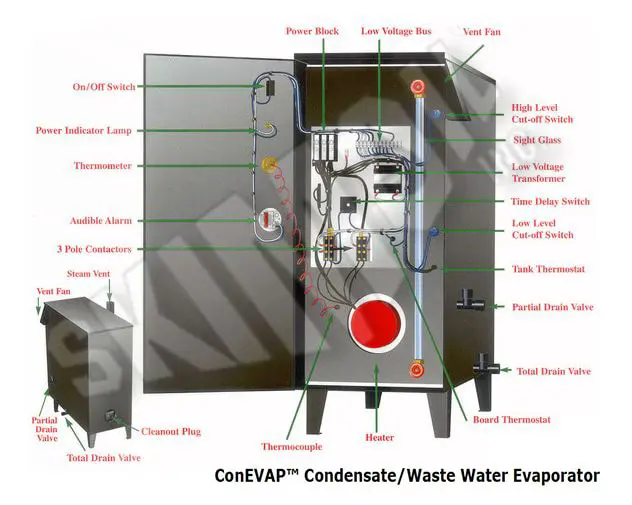
ConEVAP Capacity Chart
| Model No. | CapacityLbs/Hr Gals/Hr | KW | Amps | Volts | Shipping Wt | Phases | DimensionsH x L x W |
|---|---|---|---|---|---|---|---|
| CE-6 | 15.8 1.9 | 6 | 11 | 480 | 546 | 3 | 48-1/8 x 46-1/8 x 20-3/8 |
| CE-12 | 34.2 4.1 | 12 | 19 | 480 | 550 | 3 | 48-1/8 x 46-1/8 x 20-3/8 |
| CE-18 | 51.6 6.2 | 18 | 21.7 | 480 | 618 | 3 | 48-1/8 x 46-1/8 x 24-3/8 |
| CE-24 | 69.1 8.3 | 24 | 28.9 | 480 | 624 | 3 | 48-1/8 x 46-1/8 x 24-3/8 |
| CE-36 | 104.1 12.5 | 36 | 43.4 | 480 | 633 | 3 | 48-1/8 x 46-1/8 x 24-3/8 |
| CE-54 | 156.6 18.8 | 54 | 65.0 | 480 | 819 | 3 | 48-1/8 x 46-1/8 x 44-3/8 |
| CE-72 | 209.1 25.1 | 72 | 86.7 | 480 | 834 | 3 | 48-1/8 x 46-1/8 x 44-3/8 |
3-Stage Separation Process
1. Dual Turbulence-Free Separation Chambers
Water enters the first chamber and flows through a coalescer pack. Small oil particles coalesce and separate. Clean water flows by gravity into the second chamber and repeats the process.
2. Secondary Gravity Separation
A second chamber contains polypropylene balls or tubes to extend separation time and surface area. More oil is pulled from the water.
3. Activated Carbon Polishing (GAC)
A large volume external activated carbon filter finishes the job — polishing the effluent and removing sheens. Almost all municipal sewer systems accept this level of discharge.
Environmental Compliance = Required
Environmental regulations now classify air compressor condensate as hazardous or regulated oily waste. Discharging untreated condensate can lead to fines or shutdowns.
✅ Comply with discharge limits ✅ Eliminate hauling costs ✅ Avoid surprise inspections
What If Your Oil Won’t Separate?
Some compressor lubricants—like polyglycols and phosphate esters—have a higher specific gravity than water or contain additives that form stable emulsions. These can’t be removed by gravity separation.
Solution:
See the ConEVAP™ Compressor Condensate Evaporator
- No emissions
- No moving parts
- No more discharge
- Just evaporate the water — leave the oil behind
At 211°F, it’s just water. At 212°F, it’s vapor. Let’s get rid of it.
Let’s Size Your CCS System Right
- Whether you need 7.5 or 400 gallons — or just want to eliminate water entirely — we’ll help you select the right system the first time.
P.S. Don’t wait until your maintenance team finds oil in the scale pit — or your discharge test fails. Get the CCS or ConEVAP and handle your condensate once and for all.